 RadixPro
Choosing the best Custom Motors manufacturer in China requires more than comparing prices. Global buyers need stable performance, clear communication, and dependable after-sales support. A capable factory should understand voltage requirements, torque targets, operating temperatures, and installation limits. It should also provide practical engineering support before production begins. The right partner listens carefully.
Factory experience becomes visible in small details. Engineers should explain winding choices, bearing life, insulation systems, and expected noise levels. During a plant visit, buyers may see copper wire preparation, rotor balancing, assembly stations, and end-of-line testing. Reliable manufacturers record test results for each production batch. They should also discuss certifications, packaging protection, lead times, and replacement procedures without avoiding difficult questions.
No supplier is perfect.
The strongest manufacturers admit technical limits and correct mistakes quickly. A rushed quotation can hide unclear tolerances or unsuitable materials. That risk deserves attention. This article examines why China remains a serious sourcing destination for Custom Motors and how global buyers can evaluate manufacturers with confidence. It considers product quality, engineering capability, factory controls, customization flexibility, and communication practices. These factors matter when motors must run continuously in pumps, fans, conveyors, medical equipment, or automated machinery. However, a low price should never replace verification. Sample testing, reference checks, documented specifications, and transparent production updates create a safer purchasing decision. The goal is not to claim one universal winner, but to identify a manufacturer that matches each buyer’s application, standards, budget, and long-term service expectations.
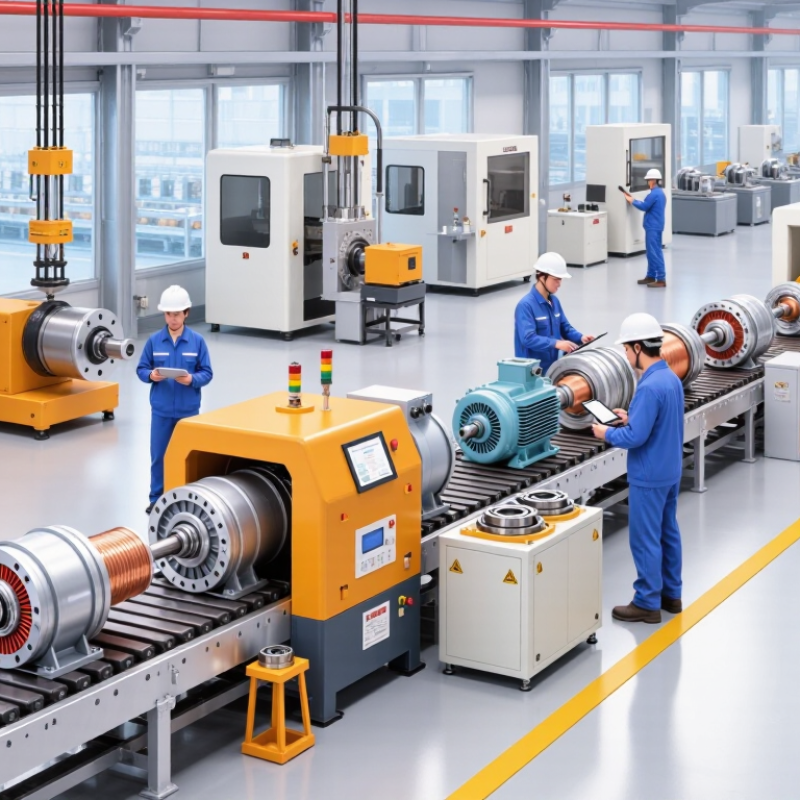
China’s motor industry offers enormous production capacity for global buyers. Manufacturers serve pumps, fans, compressors, conveyors, and specialized machinery. Large production volumes can reduce tooling costs and shorten replacement cycles. However, scale does not automatically guarantee stable quality. Customization still depends on engineering discipline, testing, and communication.
The often-cited 46% electricity figure needs careful reading. It usually describes electricity used by motor-driven systems, not motor factories alone. This context matters when buyers compare efficiency classes, control methods, and operating costs. A motor running continuously in a factory can waste more energy than its purchase price suggests. Buyers should review efficiency data at real loads, not only at rated conditions. Export experience also matters. Voltage, frequency, insulation, shaft dimensions, protection ratings, and packaging must match the destination market. Small details cause expensive delays.
Tips: Ask for a sample test report, winding specifications, efficiency curves, and noise measurements. Confirm whether testing covers every unit or selected batches. Request photos of rotor balancing and final inspection. Check export packaging before mass production. A clear specification sheet prevents many misunderstandings. It is not perfect, though. Even experienced buyers can overlook installation temperature or starting current. That is why independent verification remains useful, especially for high-volume orders.
| Data Dimension | Verified Data or Benchmark | Year / Period | What It Indicates for Global Buyers | Reference |
|---|---|---|---|---|
| China’s total electricity consumption | 9,224.1 TWh | 2023 | Shows the exceptionally large domestic energy market in which industrial motors are used across manufacturing, infrastructure, buildings, transport, and utilities. | China National Energy Administration |
| Industrial electricity consumption | Approximately 6,072.7 TWh | 2023 | Industrial demand creates a large testing and application base for induction motors, synchronous motors, variable-frequency-drive systems, pumps, fans, compressors, and conveyors. | China National Energy Administration |
| Motor-driven systems’ electricity-use context | About 46% of electricity use | Industry estimate; commonly cited China context | Highlights why motor efficiency, control systems, maintenance, and lifecycle energy cost can matter more than the initial purchase price. | China energy-efficiency industry studies; the 46% figure should be treated as an estimate rather than a separate official national statistical category. |
| Illustrative electricity volume represented by the 46% estimate | Approximately 4,243 TWh | Calculated from 9,224.1 TWh × 46% | This is a derived illustration, not an independently reported official figure. It demonstrates the potential scale of electricity associated with motor-driven applications. | Calculation based on China National Energy Administration electricity data and the 46% industry estimate. |
| China’s merchandise exports | Approximately US$3.38 trillion | 2023 | Indicates the depth of China’s export logistics, component supply chains, customs infrastructure, and overseas delivery experience. | General Administration of Customs of China |
| Global merchandise-export position | Largest exporting economy by merchandise value | 2023 | Provides a macro-level explanation for China’s strong export capacity in electrical and mechanical equipment categories, including motor products. | World Trade Organization |
| Recommended customs classification for electric motor export research | HS 8501 | Current HS classification framework | HS 8501 covers electric motors and generators, excluding generating sets. Buyers should use the appropriate subheading when comparing export values, tariffs, and product specifications. | UN Comtrade Database |
| China’s energy-efficiency motor standard | GB 18613-2020 | Effective from June 2021 | Sets higher minimum energy-performance requirements for relevant three-phase asynchronous motors and supports the shift toward more efficient motor designs. | China National Standard Information Platform |
| Efficiency classes commonly used in international motor procurement | IE1, IE2, IE3, and IE4 | IEC 60034-30-1 framework | Buyers should specify rated power, voltage, frequency, duty cycle, efficiency class, insulation class, IP protection, mounting arrangement, and applicable certification requirements. | International Electrotechnical Commission |
| Key technical variables for custom motor sourcing | Power, voltage, frequency, speed, torque, duty, enclosure, mounting, efficiency, and certification | Procurement checklist | A standardized technical specification reduces quotation differences and helps buyers compare equivalent products without relying on company or brand identity. | Based on IEC 60034 series requirements and common industrial motor procurement practice. |
| Most important lifecycle-cost factor | Electricity consumption during operation | Long-term operating period | For continuously operated motors, energy cost can substantially exceed the initial equipment price; efficiency and correct sizing should therefore be evaluated together. | International Energy Agency |
AC motors suit pumps, fans, compressors, and other machines running for long periods. They provide practical continuous operation. Check cooling and duty cycle carefully.
DC motors fit compact systems needing simple speed control. They can support straightforward designs. Confirm voltage, speed, torque, and available airflow.
BLDC motors offer efficient and quiet operation. They suit appliances, robotics, and battery-powered products. Their performance depends on correct control settings and thermal design.
Servo motors suit applications requiring precise position and rapid response. They work well when movement must repeat accurately. Real-load testing remains essential.
Stepper motors provide economical positioning when loads remain predictable. They are useful for controlled, repeatable movement. Unpredictable loads may cause missed steps.
Share voltage, speed, torque, duty cycle, shaft dimensions, noise limits, and operating temperature. Include mounting details. Airflow matters more than many teams expect.
Request efficiency curves and exact test methods. Check voltage, frequency, load, cooling, and duty conditions. IE3 or IE4 results may change at partial load.
Review test records, calibration dates, serial traceability, winding data, shaft dimensions, and insulation class. Observe vibration, torque, temperature rise, and efficiency tests. Photos are not enough.
No. Certification supports documented procedures but cannot guarantee perfect production. Check certificate scope, corrective actions, and change-control records. Small failures still matter.
Inspect seals, cable glands, covers, and drainage paths on the complete assembly. Test realistic conditions. A claimed rating may not reflect installation mistakes.
China’s motor industry offers substantial manufacturing capacity, export experience, and customization flexibility for global OEM buyers. In a market where motors account for a significant share of industrial electricity consumption—around 46% in some usage contexts—efficiency and application-specific design are increasingly important. Custom Motors can be developed in AC, DC, BLDC, servo, or stepper configurations to match different requirements for torque, speed control, precision, size, and operating conditions.
When evaluating a factory, buyers should review compliance with IEC 60034, IE3 or IE4 efficiency ratings, and GB/T 18613-2020, while also confirming testing procedures, ISO 9001 quality management, IP protection ratings, and documented performance verification. A reliable supplier should provide clear information about MOQ, lead time, pricing, warranty terms, spare parts, technical communication, and after-sales support. Comparing these factors together helps global buyers select a capable custom motor manufacturer that can deliver consistent quality, regulatory alignment, and long-term value.
