What Are the Top Types of Precision Motors in 2026?

Time:2026-11-04 Author:Madeline
0%

Precision motors are not one technology. They are a family of machines built to control motion accurately, repeatably, and efficiently. In 2026, engineers compare servo, stepper, brushless DC, linear, and direct-drive motors for very different jobs. A robotic arm needs fast, controlled positioning. A CNC spindle needs steady rotation under load. A compact medical pump may prioritize smooth, quiet movement.

Demand for better motion control is growing alongside automation and electrification. The International Energy Agency’s Global EV Outlook 2025 reports that electric-car sales exceeded 17 million in 2024, accounting for more than one in five new cars sold worldwide. That figure does not measure precision-motor sales directly, but it shows why compact, controllable motor systems matter across transport and manufacturing. The U.S. Department of Energy’s motor-systems resources also emphasize that motor and drive selection affects energy use, not just speed or torque.

Bimal K. Bose, an influential power-electronics and motor-drive researcher, has stressed a practical point in his published work: motor performance depends on the coordinated design of the machine, its drive, and its control. That matters. A high-resolution encoder cannot rescue a poorly matched motor, and a strong motor may still waste energy when its drive is oversized. This guide compares the leading precision motor types, their strengths, and their trade-offs. Some rankings remain application-dependent; “best” can be a misleading label. The right choice begins with the motion profile, load, accuracy target, and operating environment.
What Are the Top Types of Precision Motors in 2026?

Precision Motors: Key Features and Classification

What Are the Top Types of Precision Motors in 2026?

Precision Motors: Key Features and Classification

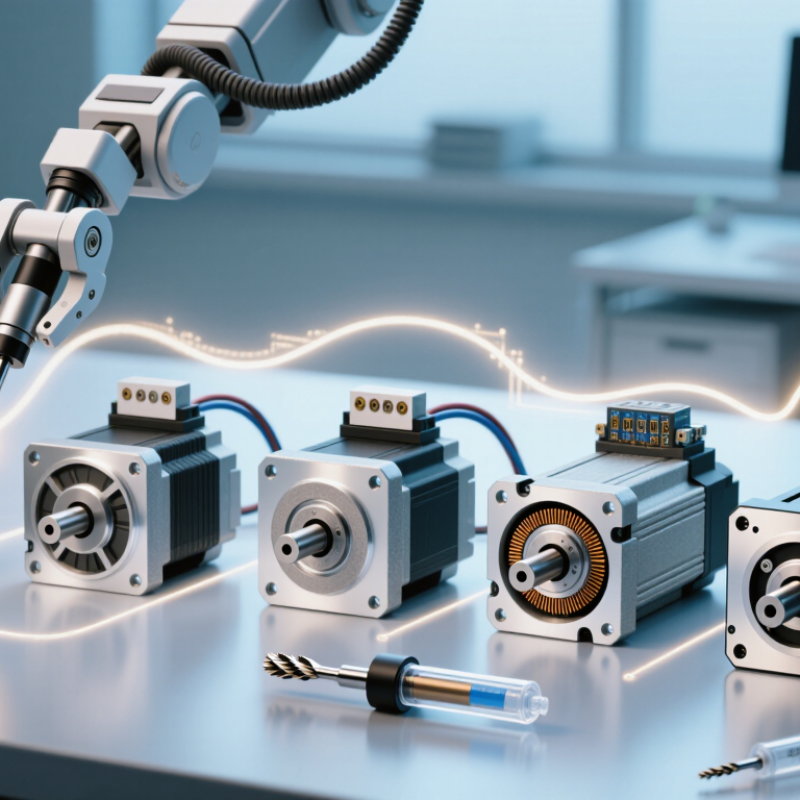
Precision motors are classified by how they move, how they are controlled, and the accuracy an application needs. Servo motors use feedback from an encoder to correct position or speed during operation. They suit robotic joints and compact automation axes that must stop at repeatable points. Stepper motors move in measured increments, making them useful for slower positioning tasks, such as adjusting a small camera platform. Brushless DC motors offer smooth rotation and efficient operation, while linear motors produce direct, straight-line motion without a rotary transmission. Coreless motors, with lightweight rotors, can respond quickly in handheld instruments. Each type has trade-offs.

Key features include positioning accuracy, torque, speed range, response time, heat output, and feedback method. A motor may hold a position precisely but still struggle with sudden load changes. Mechanical fit matters, too. A shaft that is slightly misaligned can cause vibration, noise, or premature wear. Specifications should be checked under the actual load and duty cycle, not just at no load. Precision is a system property.

Tips: Match the motor to the motion first. Check load inertia, travel distance, and required stopping time. For a prototype, record temperature and positioning errors after repeated cycles. A simple test can reveal issues that a datasheet misses. Don’t overlook wiring or mounting stiffness; small details can affect repeatability. And sometimes, the “best” motor is simply the one that is easier to tune and maintain.

Servo Motors for Closed-Loop Motion Control

Servo motors are built for closed-loop motion control. An encoder reports actual shaft position or speed, while the drive compares it with the command and corrects the error. That feedback supports repeatable moves, even when a conveyor’s load changes or a cutting head must stop within a narrow tolerance. The International Federation of Robotics’ World Robotics 2024 report counted 541,302 industrial robot installations worldwide in 2023, with 4.28 million robots operating in factories. These figures describe robotics, not servo sales, but show the scale of equipment relying on controlled motion. Feedback matters.

Selection requires more than comparing rated power. Match peak torque and speed to the move, check motor-to-load inertia, and confirm encoder resolution and thermal capacity. A servo is not automatically more accurate; that assumption deserves a second look. Flexible couplings, backlash, poor grounding, or aggressive tuning can still produce vibration and positioning error. During commissioning, watch the motor under the real load: a smooth bench test can hide heat buildup or overshoot after repeated starts. Closed-loop control corrects measured error, but it cannot repair a loose bracket. That practical limitation is easy to underestimate.

Stepper Motors for Accurate, Incremental Positioning

Stepper motors are useful when a machine must move in measured increments and hold a repeatable position. A controller sends electrical pulses, and each pulse advances the motor by a defined step. On a small desktop mechanism, that can mean moving a camera carriage a few millimeters, pausing, then returning to the same point.

Small moves matter.

Microstepping divides each full step into smaller commanded increments, creating smoother motion and reducing vibration. It does not guarantee matching gains in absolute accuracy. Load, friction, motor temperature, and mechanical backlash can all shift the final position. A bench test may look precise, yet a heavier tool can expose missed steps.

That assumption can fail.

For a reliable setup, match the motor’s torque to the real load, including acceleration and vertical force. Keep the mechanism aligned, and check whether heat builds during long holding periods. Open-loop control is often simple and economical, but it cannot confirm that the shaft reached its target. Where a missed position has costly consequences, an encoder or position sensor can provide useful feedback. Stepper motors suit many repeatable positioning tasks, but their performance depends on the whole motion system, not just the motor.

BLDC, Linear, and Direct-Drive Motors for Specialized Motion

What Are the Top Types of Precision Motors in 2026?
BLDC, Linear, and Direct-Drive Motors for Specialized Motion

In 2026, precision motor choice is less about peak speed than matching motion to the load, duty cycle, and allowable error. Brushless DC (BLDC) motors suit compact axes that need controllable speed and useful torque across a broad operating range. They work well in feeders, small robotic joints, and inspection stages. Add an encoder for closed-loop positioning. Heat still matters.

Linear motors create thrust directly along a track, avoiding rotary-to-linear screws or belts. That can help high-acceleration pick-and-place systems and inspection equipment, where backlash or lubrication can be costly. But the carriage, guides, and cooling need careful design. Long travel can raise costs quickly. Smooth motion is not automatic.

Direct-drive torque motors couple the load to the rotor, removing gearbox backlash and compliance. They fit rotary tables, telescope gimbals, and semiconductor stages requiring quiet, repeatable movement. The trade-off is often a larger motor and stricter thermal management. The International Federation of Robotics’ World Robotics 2024 report recorded 541,302 industrial robot installations in 2023, with 70% in Asia. That signals substantial automation activity, not a guaranteed motor trend. Test the actual payload; catalog performance can disappoint.

How to Select a Precision Motor for 2026 Applications

What Are the Top Types of Precision Motors in 2026?
How to Select a Precision Motor for 2026 Applications

Choosing a precision motor starts with the motion, not the catalogue. Servo motors fit applications needing responsive control and changing speeds. Stepper motors can suit repeatable, lower-cost positioning, though they may lose synchronisation under excessive load. Linear motors deliver direct straight-line movement; direct-drive torque motors can reduce backlash in rotary systems. Match motor type to required torque, speed, accuracy, duty cycle, and available space. A motor that performs well on a test bench may behave differently with a real payload.

The International Federation of Robotics’ World Robotics 2024 report recorded 541,302 industrial robot installations worldwide in 2023. This figure describes robot installations, not precision-motor sales, but it shows the scale of automated equipment that depends on controlled motion. For selection, check the load’s inertia, peak and continuous torque, encoder feedback, and heat dissipation. Also inspect the mounting space and cable routing. Small details matter.

Tips: Test under the real load and duty cycle. Check repeatability after the motor warms up, not just during a brief trial. Even careful calculations can miss vibration or cable drag; that is worth reflecting on before final sizing.

What Are the Top Types of Precision Motors in 2026?

How to select a precision motor for 2026 applications

The illustrative 1–5 fit index summarizes common engineering strengths for precision-motion tasks; it is not a measured specification or a universal ranking. Choose based on required accuracy, speed, load, travel, feedback, thermal limits, and total system design. Linear motors suit direct linear motion, voice-coil motors suit short-stroke motion, and rotary servo, direct-drive torque, and closed-loop stepper motors serve different rotary-motion needs.

FAQS

How does a servo motor improve motion control?

An encoder measures shaft position or speed. The drive compares feedback with the command and corrects measured error. Feedback matters.

Which motor type suits compact, controllable motion?

A brushless DC motor can suit feeders, small robotic joints, and inspection stages. Add an encoder for closed-loop positioning. Heat still matters.

When is a linear motor a good choice?

Linear motors create thrust directly along a track. They can help fast pick-and-place systems avoid screw or belt backlash. Guides and cooling need careful design.

What are the benefits of direct-drive torque motors?

They connect the load to the rotor, reducing gearbox backlash and compliance. Rotary tables and precision stages may benefit. Thermal management can be demanding.

Are stepper motors suitable for positioning?

They can work for repeatable, lower-cost positioning. Excessive load may cause lost synchronisation, so test with the real payload.

What should I check when selecting a precision motor?

Match torque, speed, accuracy, duty cycle, and available space to the application. Check load inertia, encoder resolution, cable routing, and heat dissipation.

Why test a motor after it warms up?

Repeated starts can reveal heat buildup or overshoot that a brief bench test misses. A clean test can feel reassuring, perhaps too reassuring.

Can a servo correct every positioning problem?

No. Feedback can correct measured error, but it cannot fix a loose bracket or poor grounding. Check couplings and tuning, too. I would not trust calculations alone.

Conclusion

Precision Motors are designed to deliver accurate, repeatable motion in applications where speed, position, or force must be carefully controlled. Their key features include precise output, responsive operation, and the ability to suit different motion requirements. Servo motors use feedback in a closed loop to adjust their movement in real time, making them useful when dynamic control and accuracy are essential. Stepper motors move in defined increments, offering straightforward positioning for tasks that do not require continuous feedback.

For specialized needs, brushless DC motors can provide efficient rotation, while linear motors create direct movement along a straight path and direct-drive motors transmit motion without intermediate gearing. Selecting a precision motor for a 2026 application involves considering factors such as required accuracy, load, speed, operating environment, control method, and system integration. Matching these needs to the motor’s operating characteristics helps create reliable, efficient motion systems.

Madeline

Madeline

Madeline is a dedicated marketing professional with a wealth of expertise in our company's core offerings. With a keen understanding of the industry, she brings a unique perspective to her role, consistently delivering high-quality content that highlights the superior aspects of our products. As......